
Traditional industrial robots and cobots are typically fixed to the floor. However, mounting the robots on a mobile platform creates what is known as an IMR (Industrial Mobile Robot). This opens up entirely new possibilities. For example, loading and unloading tasks at machines and production lines can be combined with transport and order-picking tasks. The ability to quickly adapt to changing layout conditions also increases flexibility. However, this new technology also poses new challenges for occupational safety
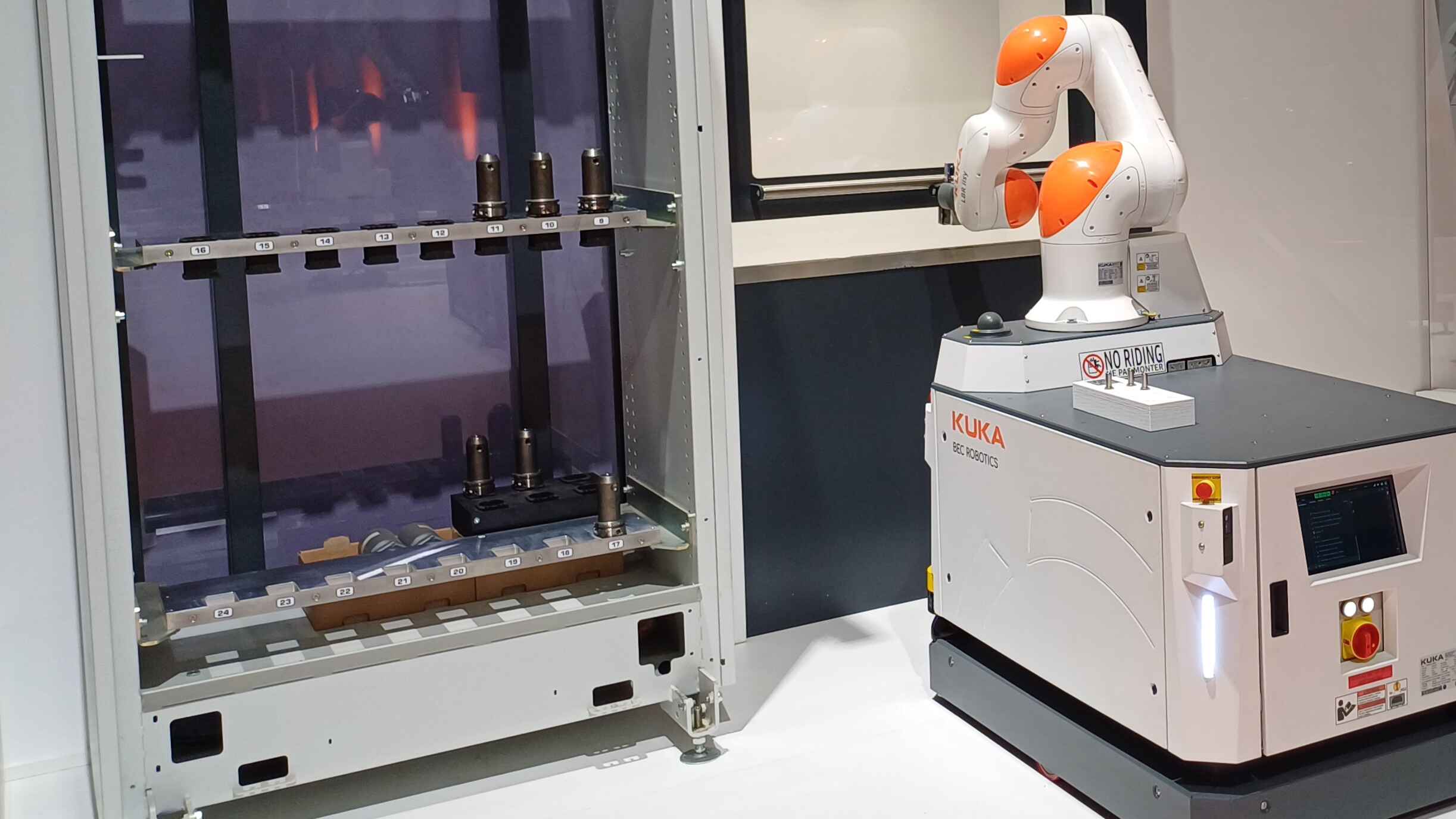
Photo: Umb/Kuka/Heller
New ISO 26058-1 standard aims to fill the gap
Since mobile industrial robots are classified as machines, the minimum technical requirements for the EU are set forth in the Machinery Directive and, starting in January 2027, in the Machinery Regulation. More specific requirements are typically defined in standards. Unfortunately, however, there is still no specific standard for IMRs. Manufacturers and users must therefore make do by combining the technical requirements from two standards:
- For the mobile platform: EN ISO 3691-4:2023. This standard actually applies to so-called driverless industrial trucks (also known as AGV), but is currently also used for mobile robots.
- For the robotic part: EN ISO 10218-1:2025 and EN ISO 10218-2:2025. These well-known standards for industrial robots have been applied for many years to all types of industrial robots (6-arm robots, linear robots, SCARA robots, etc.).
To provide users with requirements specifically focused on IMRs, the new standards project ISO 26058-1 (Safety Requirements for Mobile Industrial Robots) was launched. A review of the initial draft documents for this standard reveals the following:
Typical mechanical risks associated with IMRs include, for example, collisions, entrapment between the IMR and its surroundings, falling objects, drawn in, and running over. As required by law for machines, these risks must be analyzed and assessed in a risk assessment, and appropriate protective measures must be derived. One of the most common protective measures to protect from these risks is the use of optical protective devices, such as laser scanners. These safeguards immediately stop the hazardous movements of an IMR when a person approaches.
For simple driverless industrial trucks, the respective travel speed may be sufficient to calculate the appropriate safety distances. However, if robots are installed on the mobile platform, the mobile platform and the robots may move simultaneously. This makes calculating the safety distances more complex. If collaborative robots are also installed on the mobile platform, additional standards apply, such as ISO PAS 5672 or ISO/TS 15066.
According to the current status, the Performance Level (PL) or Safety Integrity Level (SIL) for the safety-related control systems of IMR is to be determined using a matrix similar to the well-known risk graph specified in EN ISO 13849-1.
When is ISO 26058-1 expected to be published?
- December 2026: CD survey; publication and comment period for a Committee Draft (CD)
- December 2027: DIS survey. This draft will be presented to the public.
- September 2028: Publication of the final ISO 26058-1
Currently, further coordination is going on between ISO/TC 110 (Industrial Trucks) and ISO/TC 299 (Robotics) regarding the technical distinction between IMRs and driverless industrial trucks. ISO/TC 299 WG 14 aims to have the future ISO 26058-1 listed as a harmonized EN standard under the Machinery Regulation.
The future ISO 26058-1 will not apply on humanoid robots.
Conclusion
Mobile industrial robots can improve safety in production by taking over heavy, unergonomically tasks. In addition, IMR navigation can be safer than that of forklift drivers, as human operating errors are largely avoided. The risks associated with IMRs must be analyzed and assessed in a risk assessment, and appropriate protective measures must be derived. Safe sensor and control technology are conditions for flexible human-machine interaction.
Note: This article is a translation of German websites

